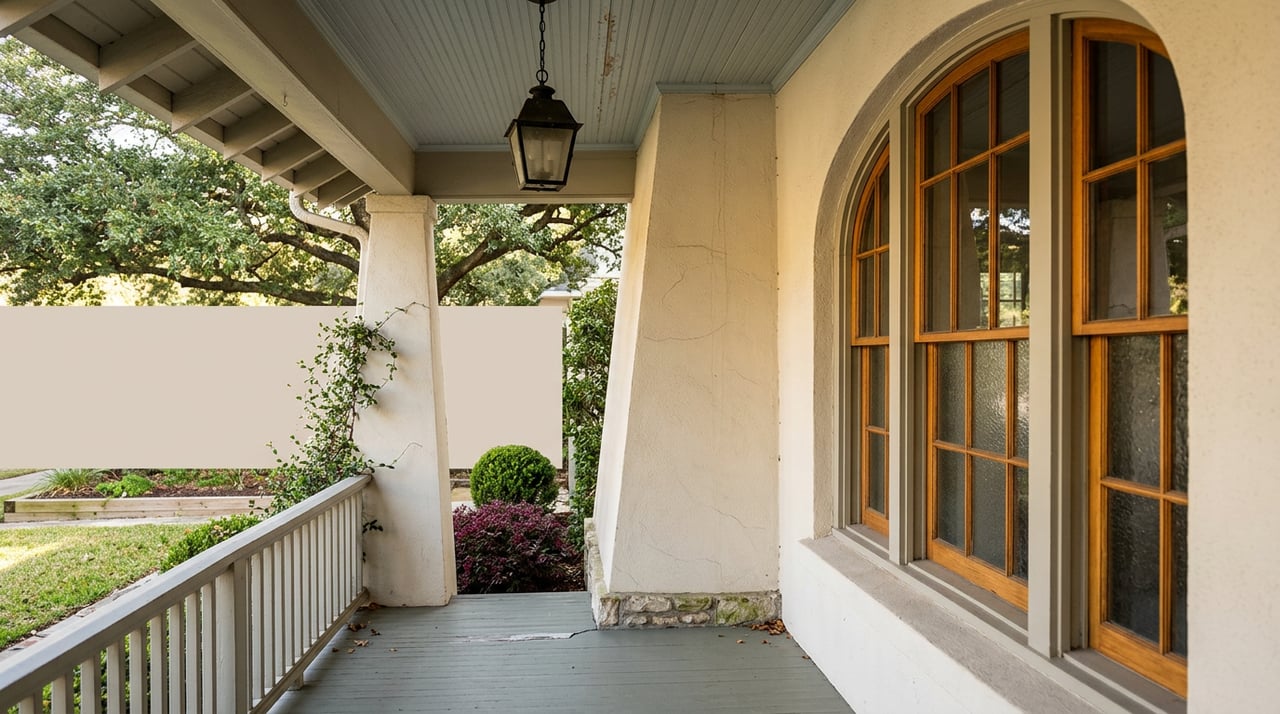
Two buyers stand on the porch of the same 1920s Craftsman on a Monte Vista side street, and they're worried about the same two things in the wrong order. The first worry is the historic designation. Will the city tell them what color to paint the trim, whether they can add a window, whether their renovation plans are dead on arrival before they've even closed. The second worry is the foundation. A hundred-year-old house on Texas clay sounds like the kind of thing that ends in a five-figure repair bill before the moving truck is unpacked.
Both worries point at real risks. Neither points at the right dollar amount. The rule that scares people into thinking they can't touch their own house governs a narrower slice of the work than most buyers assume, and the foundation type that sounds alarming is often the cheaper problem to fix, not the more expensive one. The number that actually surprises Monte Vista buyers lives somewhere else entirely, behind the walls and under the slab, in the part of the house nobody photographs for a listing.
What Buyers Assume the Historic Overlay Controls
Monte Vista earned its spot on the National Register of Historic Places in 1998, and that designation is the reason the neighborhood still looks the way it does. Mature tree canopy, Craftsman porches, Spanish Eclectic facades, all of it protected from the kind of teardown-and-rebuild churn that has reshaped other close-in neighborhoods. Buyers hear "historic district" and picture a committee reviewing their choice of kitchen cabinets. That's not how the process works.
What the Review Process Actually Covers
The Historic and Design Review Commission, an 11-member citizen body appointed by City Council, reviews exterior changes to properties within a designated historic district. That's the operative word: exterior. According to the Monte Vista Historical Association's own guidance for homeowners, interior work does not need any Certificate of Appropriateness at all, though it may still require a standard city permit depending on scope. A gutted kitchen, a reconfigured bathroom, a new HVAC system run through the attic, none of that crosses the HDRC's desk.
Where exterior work is involved, the process has a shortcut most buyers never hear about until they've already found a contractor. The MVHA runs its own Architectural Review Committee, chaired by Ryan Reed, which meets the first Monday of each month at the association's office next to Landa Library. Bringing plans to that committee before filing with the city isn't required, but the association is direct about why homeowners do it anyway: it tends to produce a faster, less expensive path through the formal HDRC review than going in cold. For a buyer weighing whether a front porch rebuild or a new fence is worth the paperwork, that's the difference between a project that clears in weeks and one that drags for months.
The Foundation Question Everyone Asks Wrong
Central Texas clay soil shrinks in drought and swells with rain, and that cycle stresses every foundation in San Antonio regardless of neighborhood or price point. What changes from block to block is which kind of foundation is absorbing that stress, and that difference matters more than a home's age.
Most of Monte Vista's housing stock predates 1960 and was built pier-and-beam, not on a poured slab. That's a structurally different problem from the slab foundations common in San Antonio's mid-century belt, and different again from the post-tension slabs used in newer construction farther out toward the 1604 corridor, and each of those foundation types calls for its own repair approach. Pier-and-beam issues typically show up as settled beams, aging blocks, or crawlspace moisture, and they're addressed with leveling work under the house rather than the perimeter piering used to lift a slab. That's frequently the less expensive fix of the two, not the more expensive one, which runs against the instinct most buyers bring into an older home.
| Construction era in San Antonio | Typical foundation | Common repair approach |
|---|---|---|
| Pre-1960 Monte Vista | Pier-and-beam | Beam and block leveling, crawlspace work |
| 1970s-80s inner-loop construction | Early slab | Perimeter piering |
| New construction near outer 1604 | Post-tension slab | Engineered pier systems, warranty-period repairs |
None of this replaces a proper inspection. Texas operates under a buyer-beware standard, which puts the burden on the buyer to uncover problems before closing, and an older pier-and-beam home benefits from an inspector who works that construction type regularly rather than a generalist who mostly sees slab homes. The point isn't that Monte Vista foundations are risk-free. It's that the risk is a different shape than the one buyers walk in expecting.
Where the Real Money Actually Hides
Here's the number that doesn't show up in any listing photo or median-price headline. Homes built in the 1890s through the 1930s, which describes most of Monte Vista's original housing stock, often need updated plumbing, electrical, and foundation work that runs $30,000 to $80,000 beyond the purchase price. Pre-1940 homes in particular tend to still carry original cast iron drain lines, and replacing those typically costs $8,000 to $15,000 depending on footage and how accessible the lines are.
The porch trim is regulated. The pipe underneath it is not.
That's the asymmetry worth sitting with. The part of the house buyers worry the city will control is the part with a clear, published process and a neighborhood committee that will help you through it for free. The part that actually determines your total cost of ownership sits below the floor, invisible until an inspector's flashlight finds it, and it has nothing to do with the HDRC at all.
Running the Real Math Against the Median
Neighborhood guides published earlier this year put Monte Vista's median sale price near $425,000, inside a broad range that runs from roughly $250,000 for a condo to $1.2 million for a fully restored mansion. That range is real, but it describes purchase price, not livable cost. A buyer landing in the lower half of that range on an original, unrenovated pre-1940 property should plan to add a meaningful share of that $30,000 to $80,000 systems band before the home performs like the fully updated properties at the top of the range. The realistic entry cost for a modernized home often sits closer to the middle of the published range than the headline median alone would suggest.
That math is worth running specifically because Monte Vista competes for buyer attention against San Antonio's other established, close-in neighborhoods, the ones where land constraints have kept new supply scarce and kept resale value comparatively steady even through broader market corrections. A lower purchase price on an untouched historic home isn't automatically the better deal once the systems work is priced in. Sometimes it is. The only way to know is to run the comparison honestly, line by line, rather than by median alone.
Before You Write an Offer
- Separate the renovation you're picturing into exterior and interior scope. If it's interior, HDRC review doesn't apply, though a standard city permit still might.
- If any part of the work touches the exterior or anything visible from the street, bring your plans to the MVHA Architectural Review Committee before filing with the city. It can shorten and cheapen what follows.
- Hire an inspector who regularly works pier-and-beam construction in San Antonio's urban core, not one whose experience leans toward slab-foundation subdivisions.
- Price plumbing, electrical, and foundation modernization as its own budget line, separate from the purchase price, before comparing a Monte Vista property to a newer home elsewhere in the city.
- Use the option period, typically seven to ten days under a standard Texas contract, to get every one of these answers on paper before you've lost the ability to walk away.
A Few Questions Worth Asking Directly
Does the historic designation mean I need city approval to renovate my kitchen?
No. Interior work in Monte Vista does not require a Certificate of Appropriateness. It may still need a standard city building permit depending on the scope of the work, but that review has nothing to do with the HDRC.
Are Monte Vista's older homes more prone to foundation problems than newer San Antonio homes?
They have a different foundation type, which isn't the same as a worse one. Most predate 1960 and were built pier-and-beam rather than on a slab, and that construction is typically repaired through leveling work rather than the perimeter piering common on slab foundations elsewhere in the city.
Who do I talk to before assuming an exterior renovation is off the table?
The Monte Vista Historical Association's Architectural Review Committee, chaired by Ryan Reed, reviews plans informally before a formal city application. Their office sits next to Landa Library, and going through them first is one of the more useful, least talked-about steps a buyer or new owner can take.
Comparing a century-old Monte Vista bungalow to a newer build somewhere else in San Antonio takes more than lining up two purchase prices. It takes knowing which rules actually apply, which repairs actually cost what you think, and which line items the median never mentions. Krista Boazman has spent more than 20 years working these blocks and can help you build that real number before you're standing in the option period wondering what you missed. Let's Connect.