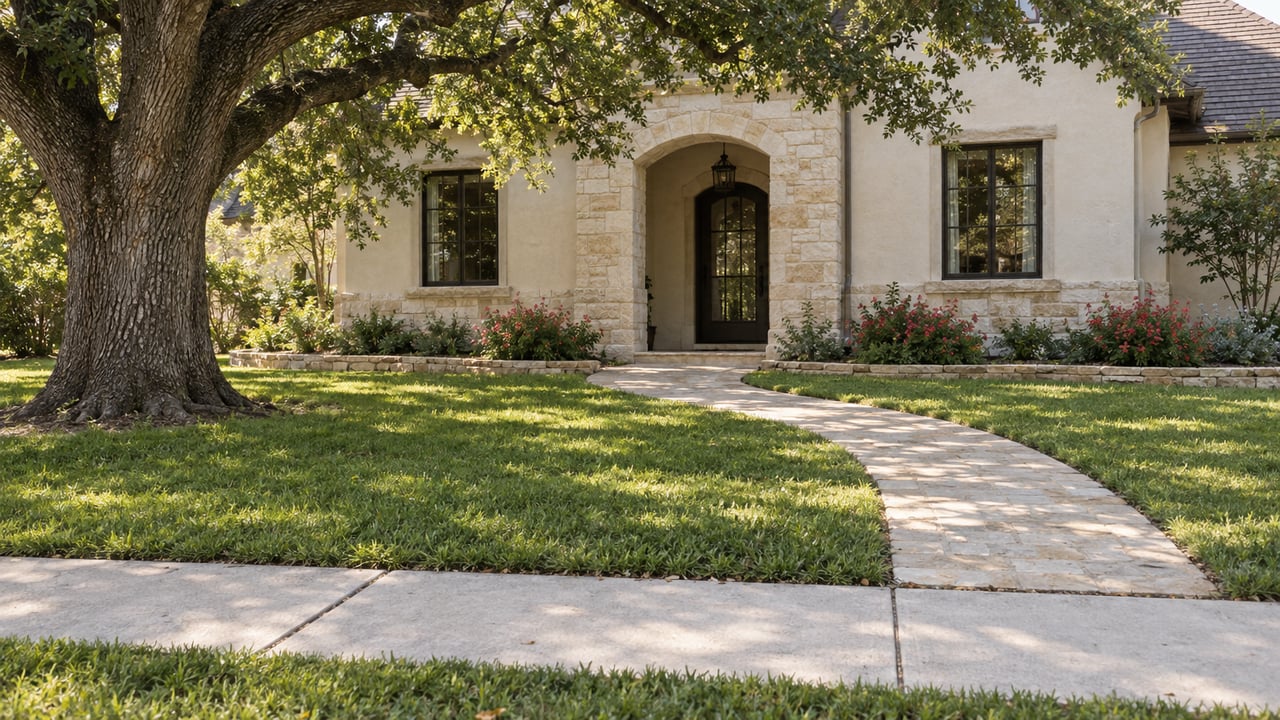
Terrell Hills has spent most of its history as a street you drive through on your way somewhere else. Broadway carries traffic between Alamo Heights and points north, lined with homes and the occasional business, the kind of corridor locals know by muscle memory rather than by walking it block to block. That's changing this fall, and not because the city decided residents needed a reason to get outside. The reason already existed. The infrastructure is only now catching up to it.
What the City Just Approved
Terrell Hills' City Council recently gave unanimous approval to a $2.4 million beautification project for Broadway Street. The scope is specific: new pedestrian walkways, heritage oak trees, and custom lighting along the corridor. Read that list again and notice what it isn't. It isn't a repaving project or a traffic-capacity upgrade. Every line item is built for someone on foot.
That's a meaningful choice for a city of 1.6 square miles that incorporated in 1939 specifically to stay independent, and that famously turned back a San Antonio annexation attempt in 1945. Terrell Hills has never needed to compete for identity. It has needed, apparently, sidewalks people actually want to use after dark.
The project breaks down into three concrete pieces:
- Pedestrian walkways along Broadway, replacing whatever gaps currently push foot traffic onto shoulders or driveways
- Heritage oak plantings, adding canopy to a street that currently offers patchy shade at best
- Custom lighting, extending the hours when walking Broadway feels like a reasonable idea rather than a slightly odd one
None of this is decorative spending dressed up as necessity. It's the city acknowledging that Broadway already has pedestrian demand it wasn't built to handle.
The Garden Tour Already Proved the Demand
Here's the part that makes the council vote look less like initiative and more like ratification. Terrell Hills already runs a self-guided tour of seven private gardens and architecturally notable homes each fall, with ticket proceeds benefiting the Terrell Hills Green Spaces Fund. That event only works if people are willing to walk from house to house on foot, in numbers large enough to justify selling tickets to it.
A garden tour is not a low-stakes ask. It requires homeowners to open their landscaping to strangers and requires those strangers to be comfortable walking residential blocks for an afternoon. Terrell Hills has been running that experiment successfully long enough to fund a Green Spaces account with the proceeds. The Alamo Heights-Terrell Hills Garden Club, whose roots trace back to 1932, represents nearly a century of exactly this kind of hands-on civic gardening in the area. The infrastructure never had to guess whether people would walk. The tour already answered that.
The Art Walk Doesn't Wait for New Sidewalks
Broadway also hosts an art walk each fall, with local galleries, studios, and artisan vendors setting up for an afternoon of curated art, live music, and family-friendly activities. Like the garden tour, this event predates any streetscape upgrade. Vendors and visitors have been making do with whatever sidewalk width Broadway currently offers.
That's worth sitting with for a second. An art walk is a foot-traffic-dependent event by definition. Galleries and artisan booths don't work if people are circling the block in cars looking for parking near each stop. The event has apparently worked well enough, year after year, to remain part of the city's regular calendar. The new lighting and walkways won't create this crowd. They'll make the crowd more comfortable.
The Community-Police Gathering Rounds Out the Pattern
Terrell Hills also holds an annual community-police gathering, with live entertainment, food trucks, and information booths, and families encouraged to bring lawn chairs and meet their neighbors. It's a smaller, more civic-minded event than the garden tour or art walk, but it belongs to the same pattern: residents using outdoor, walkable space as a gathering point, without waiting for the sidewalk to be perfect first.
Three separate events, run by three different logics (private philanthropy, small business and arts programming, and public safety outreach) all land on the same conclusion. Terrell Hills residents treat Broadway and its surrounding blocks as a place to be, not just a place to pass through. The city's own infrastructure spending is the last piece to arrive at that conclusion.
Reading the Timing Correctly
The easy read here is that new heritage oaks and lighting will finally make Broadway walkable. That gets the causality backwards. Broadway has been walkable enough to sustain a garden tour, an art walk, and a police gathering for years, using whatever sidewalk and shade already existed. What the $2.4 million project actually does is remove the friction that residents were already working around.
That distinction matters if you're trying to understand how a small, independent city allocates its money. Terrell Hills isn't betting on a future behavior it hopes residents will adopt. It's spending on behavior its own event calendar has already demonstrated, repeatedly, without being asked. The heritage oaks aren't an experiment. They're overdue shade for foot traffic that was already there.
For anyone who lives along or near Broadway, that means this fall is worth watching not for one ribbon-cutting moment but for the accumulation. New walkways paired with a garden tour that funds more green space, an art walk that already fills the same blocks, and a community gathering that treats the street as a place to sit rather than drive past. Broadway isn't becoming something new. It's finally getting the sidewalk its actual daily use has called for all along.
If you want to talk about how the Broadway corridor's fall calendar or the streetscape project might affect a specific property near it, Krista Boazman knows this stretch of Terrell Hills well enough to walk it with you.